Excerpt from Fuse
Fuse was published by Guernica Editions in 2021 and won the 2023 Canadian Bookclub Award for Nonfiction/Memoir. This excerpt is the title essay of the book, “Fuse”.
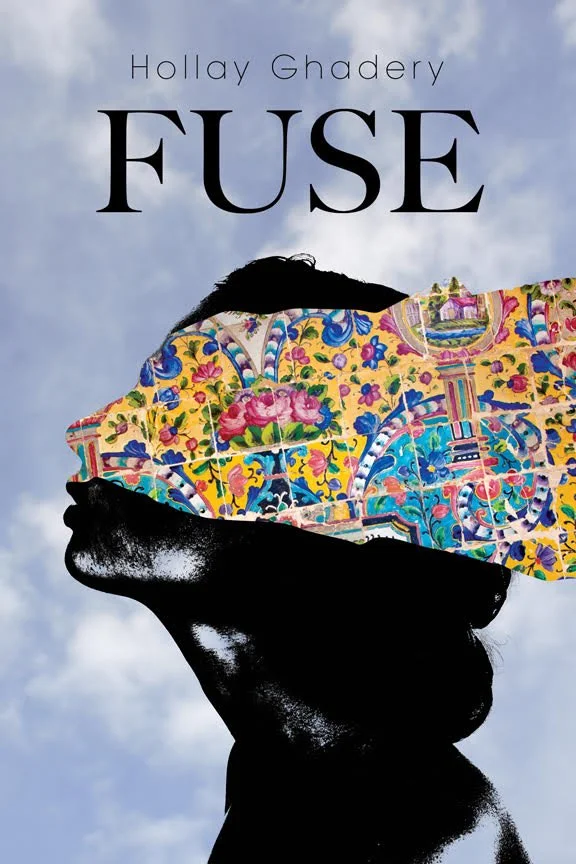
About Fuse:
Drawing on her own experiences as a woman of Iranian and British Isle descent, writer Hollay Ghadery dives into conflicts and uncertainty surrounding the biracial female body and identity, especially as it butts up against the disparate expectations of each culture. Painfully and at times, reluctantly, Fuse probes and explores the documented prevalence of mental health issues in biracial women.
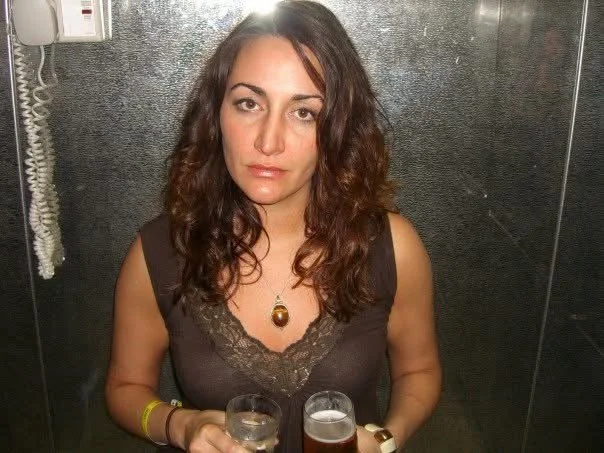
Me, in a hotel elevator, double-fisting some drinks circa 2006.
“Fuse”
Girls are dying, but it doesn’t happen all at once.
The therapist searched my file. “Which one of your parents is Iranian?” She was pulling out my intake questionnaire. The form had taken me longer to complete than our session would last. I had registered through the outpatient program at the hospital, and after three months of waiting, I received a phone call letting me know I had an appointment scheduled for the following week.
“It’s just that women who are biracial are prone to eating disorders,” she explained. I nodded. I didn’t ask why. I hadn’t cared, but when she told me this, I jerked my spine straight, grinning and shrugging loosely and dumbly as a marionette.
This happened 14 years ago. I was twenty-four, and it was the first time I’d been to a therapist. I was only there because my boyfriend wanted me to talk to someone, and I would have done anything for him.
“And people with eating disorders are more likely to suffer from co-occurring diseases like depression, anxiety, and substance abuse,” she continued, flipping through my paperwork. “And OCD. I see you’ve been diagnosed.”
My eyes darted back to her. I’d been staring at the scuffed baseboards in her office, which I was pretty sure was, or had been, a storage closet. I was hungover, trying to piece together my surroundings. It gave me a small measure of comfort to be able to order my world there, since I couldn’t remember how I’d gotten home the night before. I know there’d been live music in a dive bar. There were many vodkas and diet cokes. I remember giving a hair-tie to a girl who’d been throwing up in the bathroom. She offered me a slurred thanks and said that she usually doesn’t drink that much. I told her that I usually drink ’til I’m hot. Haha. We both thought I was pretty funny.
Focus, I reminded myself, shuffling my feet under my chair. My jeans were digging into my hips. It was 2005, and low-waisted bottoms were still a trend, to the despair of anyone with a body mass index above 23.
Focus, I told myself again. I repeated the word over and over until the swarm in my head condensed into a dull throb, and until I could clear a space to take something in.
The office had brown stains spread across white dropped ceiling, boxes crammed into corners. One was holding a bouquet of fluorescent lights. Another, a tangle of extension cords.
The therapist was still talking.
“You were diagnosed with OCD,” she repeated.
The system that gives names.
“When you were thirteen.”
That gives me Brillo pad brains.
“The co-morbidity of these diseases is well documented,” she continued when I didn’t answer. I was not sure I had even blinked. My eyes felt dry; my skin, dry; my cracked tongue, impossible.
“They’re connected.” She brought her palms together, interlacing her fingers. “There’s the need to compulsively control your world. The impulse derives from anxiety, which is why eating disorders and OCDare classified as anxiety disorders. Since this impulse is exhausting,people often resort to substance abuse—drugs, alcohol, and so on—to escape their anxieties. Then, there’s the aftermath: guilt, remorse, and the return of the obsessive need to control everything. The cycle starts again.”
Rebuild. Restrict. Release. Repeat. Got it. Drink ’til I’m hot.
The stains on the ceiling bulged oppressively overhead. I squinted, trying to erase them with my mind.
“In biracial people, this impulse often stems from tensions in the way they see and understand themselves. The technical term is biracial identity disorder. This is what happens when a person experiences no fixed identity. Each person will deal with it in a slightly different way. They may identify with one race, the other, both, or neither. Or they may identify in all of these ways—differently at various points in their lives. This lack of a solid sense of self can inform the development of those other disorders.”
She looked back at the questionnaire, and bounced the tip of her pen off one of my answers. “And along with the OCD, you were diagnosed with depression. All in your early teens.”
In addition to the questionnaire, I saw that she had medical records from my doctor. I recognized his classic near-indecipherable scrawl. My tongue loosened from the bottom of my mouth. I swallowed.
“Yes,” I said.
My mom had taken me to see our family doctor because of my fixation on cleaning and tidiness: my frantic stab at order in the chaos. I’d become undone if things in my home were messy or out of order; I would cry, scream, and hyperventilate. I would not be calmed until everything was put back together in its place, and even then, the release of tension was slow, like air leaving a tire through a pinhole.
I remember the doctor saying something about an anxiety disorder, and by the time I was sixteen, after several more visits to the doctor, I was on the drug Effexor. I know I was sixteen because when I was told that the drug might make me gain weight, I felt terrified of taking it. I remember thinking, I can’t be sixteen and fat, fatter than I already am. Girls my age were supposed to be lithe and nubile. I envisioned my body, expanding into an unrecognizable gelatinous blob—except for my nose, which hooked out like a prehistoric beak. I also remember thinking that if I took the medication, I’d need to keep it a secret from people at school, because I didn’t want to be seen as different. Defective.
“And that.” The therapist pointed her pen to my arm: “Self-mutilation. Another kind of release, another form of remorse and punishment.”
I rubbed the thick bandaging wrapped around my forearm. The skin had already begun to heal unevenly. Eventually, I would have a puckered, jumpy scar with marked needle points on each side, right to left, from bold stitching that would itch and pull as the skin fused. But I didn’t know that then. I just knew that I didn’t want my boyfriend to leave me because I refused to get help.
“My dad,” I said.
“Your dad?” She asked, looking from my arm to my face, raising a thinning grey eyebrow.
“My dad is the one who’s Iranian.”
“Okay.” She made a note, and then nodded back to my arm.
“Want to tell me about that?”
“He wanted to go to the beach,” I said.
“Your father?”
“No, my boyfriend.”
“Okay, and?”
“And it was too much. Because of this.” I grabbed a handful of my stomach. “And this.” I tapped myself on the temple. It was too much, but I didn’t want him to stop loving me for being too messed up, so we went. We drove along a country road and the way the paint hung off the barns kept me dead set on the grey vein of land.I hung off his words, scanning the lake—its wide wet eye, an open wound on my right.
“You’ve gotta lighten up,” he’d said.
I’d worn a floppy hat, big sunglasses, capris, a t-shirt. The sight of my thighs squashed against the seat made me want to gag.
“That’s the point,” I told him, gesturing around my body, to the rumpled free-fall of my flesh. “That’s exactly what I’ve been trying to do.”
That day, he swam and ate, and got on with the other day-trippers. I waited on that beach, watching his head bob. I thought that I could wait. I could be beach-nailed as long as he pleased. I thought, okay, give me sea-shelled kisses, sun and suede-soft skin, ink-stained khaki shorts on the shore, this coke-flat feeling, and I’ll sit here and wait forever, or as long as he pleased, because of all things, I loved him best.
The cut came later that day. That night. My mind was moving too fast. I couldn’t fall asleep, and he was sleeping so perfectly that I was furious with him for every perceived injustice his perfection carried. I’d woken him up. Or tried to. And when he wouldn’t wake up, I’d yelled, and when he got upset, I cut my forearm with the biggest knife I could find.
“How did he react?” the therapist asked.
The blood made him move. He was up and we were at the hospital before I could think of what to say to the doctor who sewed up my arm.
“What did you tell the doctor?”
I told him the truth: that I did this to myself, that my boyfriend had nothing to do with it. I don’t know if the doctor believed me. He remained tight-lipped through the procedure, except to say: “I could sew this up more neatly, but I need to be somewhere else.”
Whether he meant he needed to be with other patients or just get far away from me, I didn’t know, but either way, I couldn’t blame him.
I wanted to be far, far away from me too.
“And your boyfriend? Was he supportive?”
He’d wanted to know what I was going to do if I ever had a kid—what I planned to say about the scar. I told him that I’d say it’s magic. It could be a story about a caterpillar who fell in love with a girl and wanted to stay with her, always. The caterpillar didn’t want to turn into a butterfly and forget her, since it’s so easy to change and forget. So he crawled up on her arm and fell into a deep sleep.
Because love is like that.
My boyfriend said that I should just tell the truth. Black is black.
White is white.
I said to the therapist: “He was as supportive as one could expect, having to deal with me and all.”
“Deal with you? Explain that.”
A few days earlier, he’d come back from a business trip, bringing with him stale train air, some scotch, a batch of expense reports for dinners and hotels, and an admission pass to a botanical garden.
He had to leave again soon, so he was trying a pointed approach. No time to mess around. He wanted to know what was wrong. No, that wasn’t it. He knew what was wrong. We’d known each other for a few years by then. He wanted to know if he could do anything to fix it. I didn’t know. I never did. But on that day, I knew that I was feeling desperate, because I’d been refusing to eat. I was refusing to eat, still. I’d just lost my job bartending at a local pub because I was having trouble retaining orders.
I wasn’t going to tell him this, though. Not yet. He warned me that working as a bartender could make me feel worse about myself, and it had. There was the alcohol-induced attention from guys, and the knowledge that people were looking at me. And seeing . . . what? I didn’t know, exactly, but I assumed the worst, because Julia Roberts’ character in Pretty Woman had it right: The bad stuff is easier to believe. And I believed every bad thing about myself that crossed my mind, which gave me one more reason to try to empty myself of feeling anything that would remind me that I was tied to my body. I’d finish work, and then I’d drink. I was always hungover, tired, and hungry. I’d been fired, but my boyfriend didn’t know this. What he noticed was that I’d been spending a lot of time in the bathroom after meals and had lost weight.
He’d offer me a plate of dates, an apple, almonds, and I’d shake my head. No.
I didn’t tell the therapist how I never even tried to make it easier on him. I didn’t tell her how once, after I’d thrown up so hard that my abdominal muscles screamed in pain, he made me herbal tea and started talking to me about our first date.
He’d said: “You told me I that wouldn’t want to get involved with you. Remember? And when I asked why you made that little cuckoo motion at the side of your head.”
He dried his hands on a tea towel and tossed it in a lump on the counter. My stomach tightened even more. I didn’t remember saying that.
“Yeah,” I said. “I was pretty drunk.”
“On our second date, I took you to an ice cream parlour, and you ate raspberry frozen yogurt. Your shirt was the same colour as the counter. Do you remember? The colour?”
I shook my head. “No.” Although I did remember it: an elated pink. The colour was memorable because I usually wore a lot of black.
The mug of tea in my hands was so hot it burned my fingers, but I refused to put it down. Pain was familiar, steadying, and I was afraid of where my boyfriend was taking the conversation.
He sighed and leaned back against the counter, his long arms bowing out behind him. “You know,” he said, “I went through your closet, looking for that top once. It wasn’t there. I was tempted to ask where it was.”
I’d thrown the shirt out years ago, but I didn’t tell him this.
“Instead,” he said, turning to the cupboard behind him and putting away the canister of tea, “I stopped hoping I’d see you wear it again.”
I stared at the back of his head: a curly, honeyed oblivion. I didn’t tell him that I threw out the shirt because it reminded me of that day.
His face, I recalled, was a radiance of expectation and that shirt had been fitted and cropped, showing a trimmer stomach, a belly-button ring. It reminded me that things change so quickly—between us things changed—and I didn’t want to remember anymore.
“You never know.” He turned and took the mug out of my hand, putting it on the table and crouching down to look me in the eyes. “One day, you could look in a mirror and see someone else. Like the person I see.”
—
“What I meant,” I said to the therapist, “is that I’m a tough pill to swallow. I don’t make it easy for people to love me.”
The therapist put her pen and clipboard on her lap. She leaned forward, reaching an arm out as if she was going to touch me, but stopped short and rested her hand on her knee.
“I very much doubt that’s true,” she said.
I shuffled my feet under my chair and forced out a laugh. Waving my hand, I said: “It’s amazing how little of this has to do with him.”
It’s all about a white eyelet bikini that I bought when I was fifteen. It was the 90s, the golden era of supermodels, and I’d seen Cindy Crawford wear something similar. I’d loved the bikini and tried it on in my bedroom, again and again, for months before I mustered the courage to wear it in public. When I finally did, I was at the family cottage.
“Lovely,” a relative said. “One day, that will look lovely on you.”
I’ve spent my life waiting for that day to arrive.
But there was a bikini before that: red with white polka dots. My mother had bought it for me, and my body hadn’t reached a maturity where my father objected to my wearing it. I was only three years old, but I can still remember sitting on the end of my grandfather’s wooden dock in that bikini and feeling a rising desperation. I wanted to cover my stomach, which protruded over the bottoms, bared to uncles, cousins, and brothers. The sun prickled my skin; the fine hairs on the back of my neck and arms began to stand up. This discomfort with my body, it couldn’t have been anything I’d been taught. Not then. I was too young still. I was at an age when most kids ran naked through sprinklers, unburdened by their bodies.
I told my therapist, “It’s just the way I am. The way I was born.”
What I meant was: It’s no one’s fault in particular.
It’s a little of everything.
It’s me, shortly after my boyfriend and I moved in together. I was seated at my dressing table wearing my favourite emerald-drop earrings, an exacto knife in my lap, and vomit in my hair. I didn’t need a therapist to tell me that I’d become my sickness. I didn’t have to look in the mirror to see the broken blood vessels, puffy eyes, blood running over my chest, down my stomach. My boyfriend was standing in the doorway, at a loss for words. I was glad. I didn’t need words. I didn’t want to hear: You’re sick. You’re crazy. Every definition was a narrowing of what was possible. Of what could and couldn’t be—and it tormented me.
My boyfriend had gone out for the evening; it’s a gathering with the guys, he’d said. No girls were going to be there. Shortly after he left, I received a call from one of his friends’ girlfriends. Your guy’s here with the whole gang. Where are you?
I started eating: a loaf of bread, jar of olives, seven bowls of cereal. I’d just finished downing a glass of milk when the phone rang again. I reminded myself that control starts with small acts, like not answering the phone—especially if I felt that I should. I reminded myself that solitude is a good way to kill urgency.
Another glass of milk and I was ready to burst. I ran to the bathroom and let it all flood out.
My boyfriend came home earlier than I expected.
“Baby,” he said. “There really weren’t supposed to be any girls there. It’s not that I didn’t want you with me.”
It wasn’t the first time he’d done something like this. I knew he often needed a break from me, and the binge, purge, binge, purge cycle that would build all day from the moment I woke up. It was an act fuelled by an impossible contradiction: the need to perfect my body and the need to escape it.
“Honey,” he knelt down in front of me. “I’m sorry.”
I didn’t care. I repeated this to myself: I don’t care. I’m going to run away from here.
He cupped my chin in his hand and brought my face level with his. I looked at the mirror on the closet door over his shoulder. The blood had dried darker on the glass. I couldn’t read what I wrote anymore. Bitch? Cunt? Whale?
Probably.
“Honey, please.”
I was going to run away from there with empty hands and arms wide open, buzzed and broken by each moment, and I didn’t care.
He brought me a warm, damp cloth from the bathroom.
“Do you want the hairdryer?”
I’d told him of how the sound of the hairdryer comforted me. An enveloping hum from my childhood, when my dad would dry my hair after evening baths and I’d drift off, warm and contained.
My boyfriend handed me the hairdryer and continued to dab the blood off my chest. I flicked the dryer on and held it in my lap. Closed my eyes. I felt goose bumps, a hundred fingertips all over my body: a star dying in my stomach. He worked gently, cleaning a gash between my breasts. I put a hand over his, held it there a minute. Maybe all I wanted was to feel my whole wasted body against his.
—
“It has nothing to do with him,” I repeated to the therapist.
“But he still wants me. And that’s enough, right?”
“Is it?”
It was for a while. A few years later, he let me know that our on-again-off-again relationship was permanently over by booking a flight home for Christmas without telling me. I dropped him at the airport. His calm, self-contained centre had me breathing from a hole in my heart. He said he loved me. I let him in. He let me out. He let me go.
It’s the blinking light of his laugh. On. Off. On.
I drove back to our apartment. It was winter-dusk; the sky was a sheet of muted blue. There was all this space that opened above, un- folded below, and even the trees were stripped to their waists. And the birds. They sat one by one on the telephone wires.
He left, and I was careful to think of him in increments: digestible morsels. A wrist, thick blue veins, lips on that warm patch of skin behind an ear, the small of his back. That indent on his forehead where my thumb fit perfectly. I was careful to remember him just like this: a plate of dates, an apple, almonds.
A re-imagined slice of afternoon where, when I’d shaken my head at the plate, he’d understood that I didn’t mean: All this is your fault. I’d meant: It’s always the same. I’m hungry as hell, but I can’t tell if it is coming from my gut anymore.
At the time of the appointment with the therapist, my boyfriend was all I had. He had been all I felt I had for years. I told her about how my father had cut me off financially and emotionally when I had refused to transfer to a university closer to home after one year away.
He’d driven three hours to my campus, and took back the car he’d given me when I was sixteen. He didn’t tell me he was coming. It wasn’t something he would have announced to my face, but my father was the uncontested sovereign of our family: a godlike figure. As with God, messages seldom came directly from my dad, but through someone else—someone receptive, or devoted, or too afraid to argue. It was my mom who told me. She said I should lock the keys in the vehicle.
He had the spare set, and would be there later to pick up the car.
“He says you’re treating your body like a human toilet,” she informed me.
“What?” I told myself that I didn’t know what that meant. But I knew. I’d grown up knowing, hearing my dad talk to his friends or family on the phone in Farsi. Khar kos seh. Jendeh. At first, I did not know what these words meant, only that they were meant to be spat out.
Eventually, relatives visiting from Iran would tell me. They meant: Your sister’s a whore. They meant: Slut. I learned that women are either prostitutes or angels. They can never be both, and certainly never both at once.
“He says he knows people there, and they see you. He says they’ve seen you with boys.”
I’d been sitting in front of my computer, the cursor blinking where I’d left off writing an essay. “Of course I’m with boys,” I’d argued. “I’m at a co-ed university. Not a convent.”
“He has pictures.”
I was chilled. I didn’t want to hear more, didn’t want to know.
Jendeh.
I still don’t know why my mother told me this. I can guess: She was fighting with my dad, and wanted me to be as upset with him as she was. Or she wanted me to be ashamed of myself and come home.
Or she thought she was preparing me for an eventual head-to-head with him by simply telling me the truth. Whatever the case, there’s no doubt my being away was making her life difficult—or more difficult than usual, because there had always been tension between my father and mother, as far back as I can remember.
The therapist nodded, scratching her knee. Since she was still holding her pen, she ended up leaving a scribble of ink on her grey dress pants. “That may have been the case. The anxieties and disorders you are experiencing are more likely to crop up in women whose racial and cultural lineage is drastically different: like Russian and Chinese. Or like yours, of Iranian and white European. If you were to take someone else, of Italian and Greek descent, for example, the differences in their rearing approaches would not be as significant, even though these races are technically different. They share many of the same cultural values. Of course, most of us have to do some negotiating with the outside world to fit into predetermined standards of beauty. However, biracial individuals, whose parents’ backgrounds are also mark-ledly different in terms of culture, are often forced to fight a battle within the home as well: between diverging preconceptions about desirability and decorum, and the fundamentally different meanings attached to them. It’s a clash between cultures.”
She noticed the mark on her pants and rubbed at it with her thumb half-heartedly before continuing. “And since women generally bear the brunt of aesthetic and moral expectations in any race or culture, biracial women are the ones most likely to suffer.”
She flipped a wrist with a tight flourish, as if by offering this long-winded explanation, she was offering clarity. But it meant nothing to me then. My dad had cut me off, sure, but I’d wanted out. Take the car. Take the funding. I wanted to be free, so I buried what my mom told me along with everything else, not realizing that even dormant words have lives: They take root.
“I know my dad loves me,” I told the therapist. “He always told me that I’m beautiful. Beautiful and smart.”
Jeegaretō bokhoram. Khoshgeleham. I’ll eat your liver, my beautiful.
She gave me a dial-tone stare. “It has very little to do with an absence of love,” she said. “Often, there’s too much of it.”
I loved him too. All of my family—I loved them all. So even though my dad had cut me off, I visited home as much as I felt could be managed, and always without my boyfriend. It went without saying that he was not allowed in my parents’ house. I had moved away, and I was in a space that my father could not condone. My boyfriend was part of it; this sinister, chasmic darkness. So I spent Easters, Thanksgivings, and Christmases eating and drinking and throwing up in the bathroom. I think everyone knew, but the only person who ever spokeof it was my mother.
“Your father knows,” she’d said. It was an accusation and a plea. My mother was desperate and I could tell she didn’t want to talk anymore about it, so I hugged her and said okay. It’s okay. I’ll take care of it. Because I could tell she wanted to be far, far away from it.
I didn’t blame her. I wanted to be far away from it too.
—
Years later, I would meet Matthew and we would get married. We would have a child: a son, and the first boy to ever own my heart completely. He would be three days old and we would be at his first doctor’s appointment. He would be wearing a yellow and white Winnie the Pooh onesie that I’d swear was smaller on him since the morning.
I’d think, please slow down. Stop growing so fast. Stay little and with me always.
My father and I would still be distant, so my son would be five weeks old before my dad would agree to meet him, his first grandchild. But everything would change when he did. The world would expand a little. He’d want his grandson close, close to him, and all would be forgiven. We’d both forgive each other because we love him so, so much.
Around this time, I worked up the nerve to ask my mom why she told me about the names my dad called me—about the things that he’d said. I didn’t want to argue, but now as a mother myself, I had to know her reasons for relaying that information. I didn’t understand; I couldn’t imagine why I’d tell my child something hurtful that someone said about them. But I was also a new mother. I thought, maybe, there was a reason and I was missing it. My mother said that she couldn’t remember telling me any of those things; she insisted that she hadn’t.
But yes, she conceded, my father had said stuff like that. When I asked my dad about calling me these things to my mother, he said there are some things that a parent should never repeat to their child. Your mother, he said, should have known better than to tell you.
Years later, when my son asks me about my scar, I tell him the story I’d practiced. “It’s magic. It’s the story of a caterpillar who fell in love with a girl. He loved her so much that he didn’t want to turn into a butterfly and forget her. He wanted to be with her always, so he crawled up on her arm and fell into a deep sleep. Eventually his body became imprinted on hers, leaving this mark on her arm.”
I told my son this story because I wanted to protect him from my jagged limitations, but I also felt, from the moment I saw him, an urge to offer up some sort of explanation. The story I created was my first stab at coming clean. I’d learn, though, as I started telling him more stories—as I started the painful process of trying to make sense of myself and the world that made me—I’d start to understand that things would never get cleaner, just clearer. Black is black, and white is white, but love: He showed me love is every conceivable colour.
“Fuse” is excerpted from Fuse, published by Guernica Editions, 2021. Copyright Hollay Ghadery, 2026.
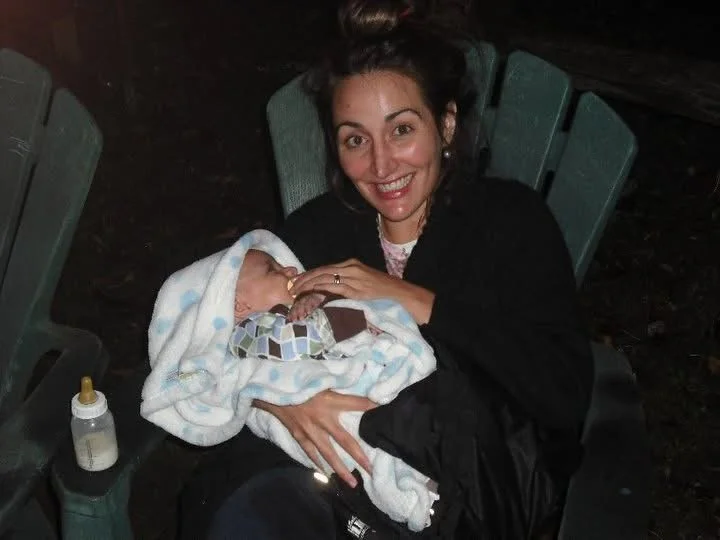
Me and my Joe, 2010.