Fuse was published by Guernica Editions in 2021.
We were walking in the rain, this guy and I. I’d just met him at a campus party and didn’t know his name—didn’t know or couldn’t remember.
“Ben?” I guessed.
He’d said: “No, and I’m not telling you again.” Even though, like I said, I wasn’t convinced he had told me in the first place.
I shrugged. “Suit yourself!” Because it made no difference to me anyway. He could have been anyone. I was just a girl with a buzz and a hacksaw heart looking to disappear, and I needed someone to help make that happen. The night before it had been someone else. Tonight, this guy.
And man, this guy.
In my blackout twenties, there were a lot of guys, but this one had the greenest eyes I’d ever seen. For the first few minutes we talked, I thought his eyes were blue because he carried himself like a man with blue eyes, with that distant ease. But no. His eyes were green, all shades of green, really, like a rainforest. He took my hand when we crossed the street, and my soul turned to steam. I could feel it: Where I ended and where the world began was getting less clear.
It had been my idea to leave the party. I’d been bored, but mostly I’d wanted to leave because the only booze they had left was beer, and that
had too many calories. I was already feeling squeezed into my pants.
“Hope you don’t mind that I wanted to leave,” I’d said as we walked to his car. He’d parked it in a municipal lot, a couple blocks away.
“Not at all,” he said. “I’d been there too long anyway. That was my buddy’s place. How do you know him?”
“I don’t know.” I’d been invited by a friend of a friend. That friend was still there, presumably.
“You don’t know how you know him?”
“I mean, I don’t know him. At all.”
He smiled, and it was as soft as snow, as easy and incessant.
“What do you know?”
I told him that he walked like a little boy, and he said: “Do not.”
He did.
It was one of the first things I’d noticed about him. His right foot was slightly more turned in than his left, and he moved through space as though he was reinventing it. I found this gentle, haphazard approach to motion reassuring: I saw it as a sign that there can be imperfection and perfection all at once.
I’d needed this comfort. I’d spent the day trying to fight through a hangover caused by the previous night’s partying. I was learning that you can’t fill the void. You can only feed it.
I knew that no amount of time at the gym would fix that feeling, so I’d skipped my workout, loaded up on fast food, and sequestered myself in my apartment. There, I spent the rest of the day eating and purging and eating and purging and eating and eating until my face and body were bloated and my stomach ached and my throat burned and I thought I’d die or never, ever, ever do this again. Whichever came first, or both. At one point, I clogged the toilet and resorted to throwing up in a grocery bag.
I knew I wouldn’t win if I kept drinking like I was, but that didn’t stop me. The small amount of relief afforded by even a few hours of oblivion was worth the consequences. I couldn’t see a puddle without feeling an ocean. I didn’t know of another way to deal with the hugeness of these pressing emotions. All the hate, fear, longing, frustration, and sadness. All my unclaimed life; it was passing me by and I had no way to stop it. I had nothing but a laundry list of neuroses and a plastic bag of vomit.
When a friend called around 7 p.m. to invite me to a party, she’d offered a break from thinking about all these things. I’d looked at the half-full bottle of vanilla-flavoured vodka on my counter that I’d been avoiding all day, and thought: Why the hell not? There was always something to prove—to myself, to someone else. I was tired of having to try to prove I was worthy of trust, consideration, love. It was easier to just not be worth the effort.
I’d poured myself a drink, raised a glass and thought: Drink ’til your hot.
“Suffering produces endurance, endurance produces character, and character produces hope,” I said.
The guy laughed. “Do you know where that’s from?”
“Dunno. I just know it. Sounds like Thomas Hardy.”
“It’s from the bible.”
“Then why did you ask me, if you knew?”
“I wanted to see if you knew.”
“I’m Muslim. I don’t do the Bible.” I’d smiled at myself. It was amazing: We were drifting through our soundstage city, street lights bouncing off glistening pavement toward the sky; it was amazing that I could be with this guy, who was unloading his gaze on me, but still drift in and out, in and out of myself as I pleased.
I learned how to exist outside my body early in life. In my 1997 high school yearbook, a boy had drawn a picture of a three-humped camel with horns, tail lifted, shitting a turban shaped coil. He’d written, “Turban Maker” underneath. I didn’t understand. I was half-Iranian Muslim, not a Sikh. I was born and raised in Canada, and my mom was sixth-generation Canadian, and of British descent. He showed his friends his work, and they laughed, so when he handed me my book back, I laughed too.
Without sufficient acuity to be offended, I was embarrassed instead. I knew I’d been excluded and pushed to a periphery and fondled into strangeness. But I didn’t understand what was happening.
As I was laughing, another boy in the cafeteria narrowly missed tipping his drink over in my lap and made a crack about not wanting to spill his drink on my Persian rug. When I walked down the hall and other kids trilled ululations in my wake, I remember the feeling of being outside of my own body, becoming both spectacle and spectre. It was as if I was watching a scene in a movie. This sudden dissociation—it wasn’t easy, but it wasn’t that hard either. I was ready to disappear.
I mentioned these experiences to my mother. She told me about how when we first moved to the area and she was carpooling with a group of other women to a school event, one of them—upon learning that my father was Iranian and Muslim—remarked that people who come to Canada should adopt the culture. My mom shrugged. Some people are just small-minded. You can’t change it. Besides, my mom had wanted to know, what was wrong with being biracial? Halle Berry was biracial, and she was a serious, successful actress, as well as a beautiful and highly desired woman.
“I’m not Halle Berry,” I said. “I’m this.” I said, pointing to my ass.
“And this,” pointing to my nose.
“But we can fix that,” my mom said. The bump on my nose was so prominent that it would burn badly in the summer, cracking, peeling, and bleeding. “That can be taken care of.”
The plastic surgeon agreed. He broke my nose down the middle to narrow it, and shaved seven millimetres off the top. He said: “Now everyone will finally be able to see your beautiful eyes.”
I bought grey coloured contacts, and as for my ass, I started going to the gym. I avoided eating pizza and French fries at lunch with my friends and greasy shomneh kabob at home with my family. I ate heads of lettuce, peeling back leaf after leaf and chewing slowly. I ate low-fat cottage cheese, and, for a treat, low-fat York Peppermint Patties. I streaked my hair blonde, waxed my upper lip, plucked my eyebrows to a thin screech.
I worked on making parts of myself disappear to suit my surroundings, the way certain lizards can drop their tails to become lighter, and run faster to survive.
I went to parties, but only with my small, close group of friends. I didn’t date boys in my school. The first guy I dated was twenty-one and he lived in another town—a bigger city. I was eighteen and relieved to be able to cross the typical teenage milestones off my list without attracting unwanted attention from my peers or my parents, mostly my father. All the ways in which I was different had already made me the object of too much unwanted attention. I still had to deal with comments at school and suspicion at home, but it was nice to fly under the radar, at least in some areas of my life.
“You know,” the green-eyed guy said, hooking his arm through mine and pulling me closer, “to know the Bible, you don’t have to be Christian.”
“Is that your name?”
“What?”
“Christian.”
He laughed and rolled his eyes. I’d laughed along too, amused by myself.
His eyes aren’t the reason I remember him. They’re part of what I recall, but not the part that has made him stand out from all the other guys I’ve met and forgotten. I’m sure many had beautiful eyes. Beautiful eyes, beautiful smiles, and beautiful bodies. They had a pleasant drugging effect on me. With them, I could hardly feel the brutal rearranging of my skin-deep fragments.
I called these guys whenever I started thinking too much. The guys called me:
Sexy.
Slut.
Snob.
Persian princess.
I knew I couldn’t possibly be all these things; being them all meant that I wasn’t any of them. I didn’t exist. And if I didn’t exist, no one could hurt me. You can see the temptation.
It’s common to think that girls like me are waiting to be saved—to be swept up, away, and into a love story. This, I think, is a misogynistic view. I wasn’t waiting for anyone to fall in love with me, the real me.
The real me is the last person I wanted anyone to see. I couldn’t stand her. She was the butt of jokes. She was shady. She couldn’t be trusted.
What I wanted was to experiment with newer, better, possible versions of myself. Think of it as rigorous split audience testing: Which version of me sits better with audiences. How’d you like this? How’d you like me now? More importantly: How did I like the way their liking me made me feel? When I knew a guy was buying into whatever skin I had slipped into, I felt radiantly clever, if just for a little while. It’s easy to fall in love with this feeling.
Every new face was a fresh start, a new high.
The reason I remember this new guy was because he saw my many contradictions and he cared enough to call me on them. He and I were walking along and it started misting, a scaly film falling on our hair, on our faces. I was laughing again, gasping for air, because he was making fun of me for my repeated use of the phrase: “In a nutshell.”
“All night,” he said, “you’ve been describing yourself ‘in a nutshell.’” He stopped, put one hand on his hip and flipped the other one out. Speaking in falsetto he mimicked: “I’m a second-year English major who wants to do a PhD dissertation in postcolonial literature. That’s me in a nutshell.” “I’m a gym junkie who wants to be a lawyer. That’s me in a nutshell.” “I love BBC period dramas and don’t give a fuck what you or anyone else thinks of me. Me, in a nutshell.”
He was right. I had said that—all of it, more or less. I had the verbal incontinence that’s typical of classic booze-bender brain. I’d been showering him in a shitstorm of selfs and couldn’t decide or remember how I wanted him to perceive me. My words themselves, however, were a clarion. I spoke with pure, anaesthetic lucidity.
“So,” he asked, unlocking his car. “which nutshell are you?”
I hated trying to explain.
He opened the door for me.
I hated feeling cleaned out like that.
I cocked my thumbs and pointed them back toward myself. “I’m this nutshell,” I winked. “And you ain’t gonna crack me.”
Even though I don’t remember agreeing to go back to his place, it’s likely I did because I remember wanting to be with him. Tall, with thickly veined forearms and broad shoulders like angel wings, he was the kind of person I guessed that I could lose myself in. I could see my behaviour was dangerous. The boys, the booze: Someone could hurt me. Or I could hurt myself. I was aware of this, but I didn’t care. There was no loss of self to lament. He could have been anyone, wanted anything. It didn’t matter. When you want to be everything and nothing at once, you need to push and push and push until you feel nothing.
We were kissing in his car and the rain was beating bullets on the roof. I had my seatbelt on and was having to strain to be near him. One of his hands was in my hair and the other on the back of my neck, softly. My hands were clenched around the seat belt, and there was a vein pulsing in my neck.
He stopped, pulling back a little so our lips were inches apart.
“Look” he said. I opened my eyes. There was nothing and no one between us except electric wisps, the lingering heat of his mouth on mine, a rawness on my chin from his stubbled jaw.
And one other thing: silence.
He grinned, his forehead resting against mine; his greens eyes, huge and immaculate. “Look. You made it stop raining.
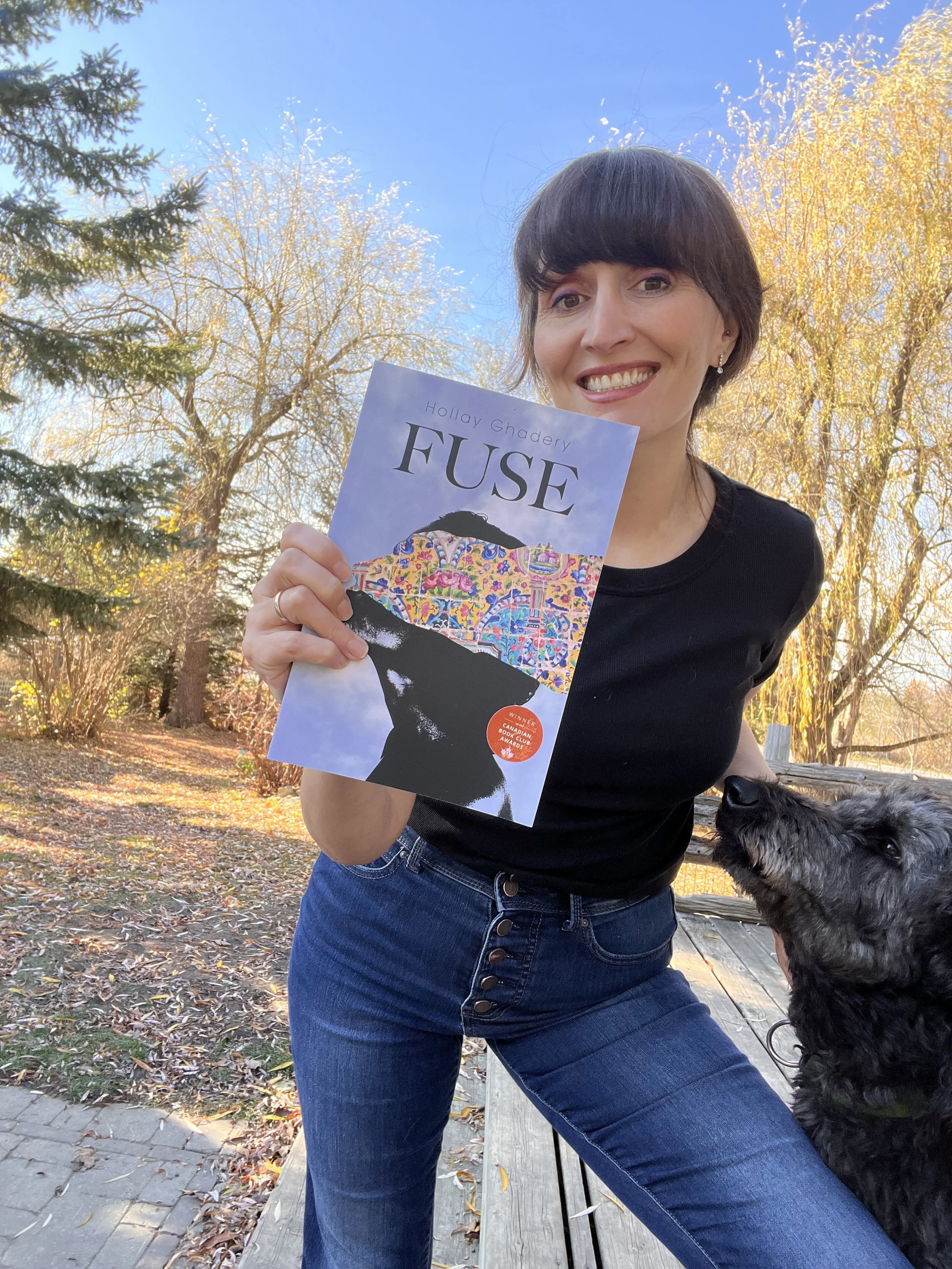
About Fuse:
Drawing on her own experiences as a woman of Iranian and British Isle descent, writer Hollay Ghadery dives into conflicts and uncertainty surrounding the biracial female body and identity, especially as it butts up against the disparate expectations of each culture. Painfully and at times, reluctantly, Fuse probes and explores the documented prevalence of mental health issues in biracial women. Fuse won the 2021 Canadian Bookclub Award for Nonfiction/Memoir.